

Mayoralty and Town twinning
Mayoralty
The Mayor is the elected Chair of the council and is the civic and ceremonial figure head for the council. The chain, badge and robes of office are an outward sign of this high office.
The Mayor is by statute the “First Citizen”, which is an honorary title and means that the Mayor takes precedence over everyone, apart from a member of the Royal Family and the Lord Lieutenant. The Mayor must be non-political and represent every section of the community. Apart from the civic and ceremonial duties and functions that the Mayor performs for the council, he or she also represents the District at all major events and historical ceremonies.
The Mayor has an important role to play in promoting the work of the council and supporting local community, voluntary and charitable organisations, and in celebrating and recognising achievements and milestones.
The Mayor and the Mayor’s Office welcomes your invitations, letters and feedback. Please be aware that the role of Mayor is ceremonial only and carries no decision-making powers. The role is entirely separate to that of elected councilor for their ward.
The Mayor 2026-27 Toggle accordion
The Right Worshipful the Mayor of St Albans City and District, Councillor Matt Fisher
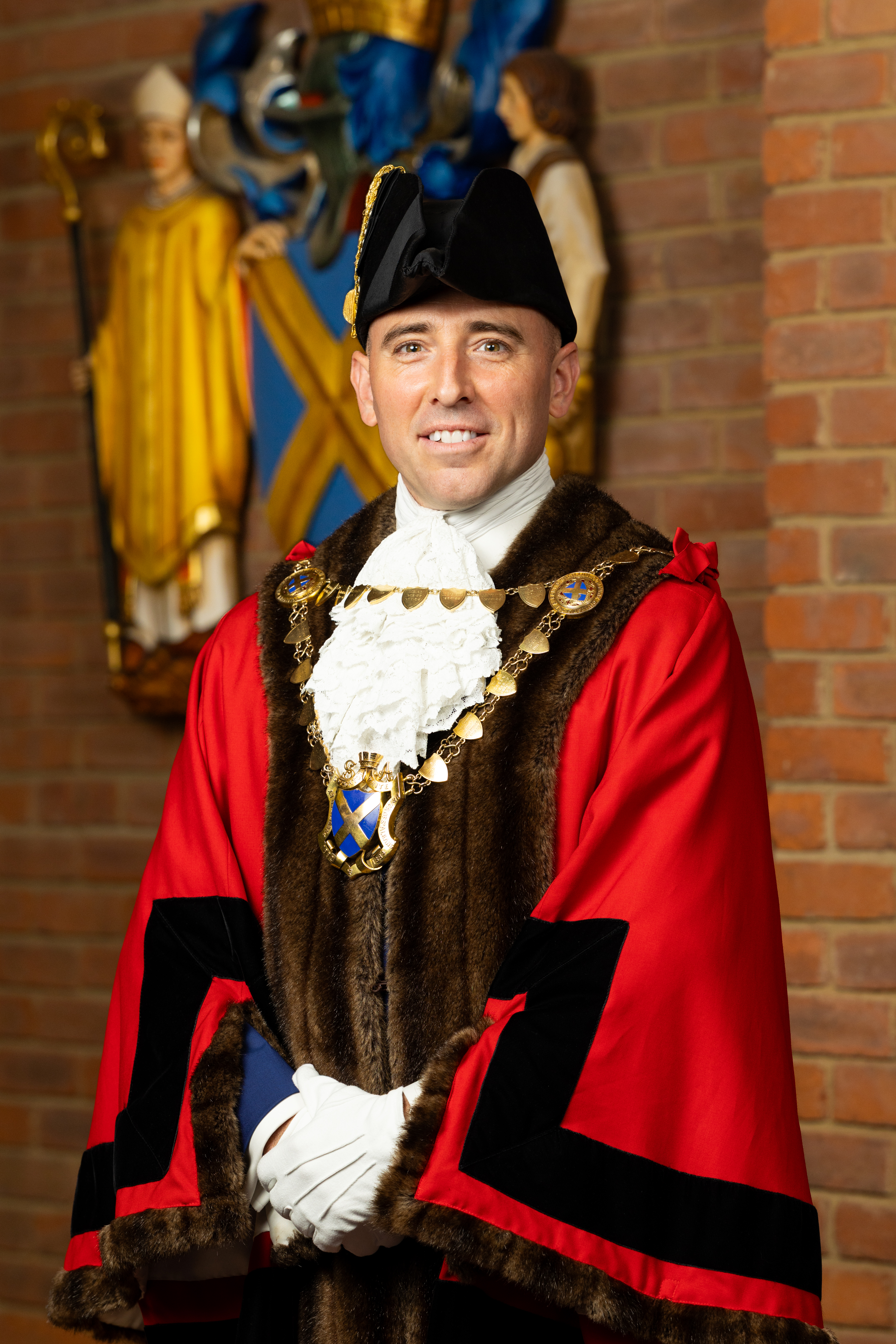
Councillor Matt Fisher has been elected the Mayor of the City and District of St Albans and will support two local charities during his year in office.
He was made Mayor for 2026/27 at the Annual Meeting of the Council on Wednesday 27 May with Councillor Juliet Voisey becoming Deputy Mayor.
Mayor Fisher, who succeeds Cllr Teresa Heritage, will raise money for St Albans Sea Cadets and Youth Talk.
The theme of his civic year is Belonging Through Service, reflecting his belief that volunteering and environmental action can help build stronger and better-connected communities.
Mayor Fisher has been a District Councillor since 2023 and represents Clarence ward. He is the City’s 482nd Mayor with the first appointed in 1553.
He will chair Full Council meetings and represent the City at a variety of events, often involving voluntary groups.
Mayor Fisher said:
It is a profound honour to serve as Mayor. This role is not simply about tradition — it is about people, community and service.
One of the greatest strengths of our District is the extraordinary number of people who quietly give their time and energy to support others every day.
I want this year to celebrate those people and inspire even more residents to get involved in their communities.
To charities and community groups across the District, I say please invite me to your events, so I can highlight your work and promote my theme of Belonging Through Service.
Mayor Matt Fisher
Matt grew up in Frinton-on-Sea, on the east Essex coast, and was involved in community litter picks and environmental projects from an early age, efforts that earned him a Green Blue Peter Badge.
He volunteered for the Sea Cadets, becoming the Lord Lieutenant’s Cadet for Essex and being named Best Sea Cadet in Britain.
Following his A-Levels, Matt took a gap year as a teaching assistant at a boarding school in South Africa in the years following the end of apartheid. He travelled extensively across Africa, climbed Mount Kilimanjaro and developed a lifelong passion for photography, adventure and humanitarian work.
He began his professional career as a harbour master before joining Essex Police and later trained at Britannia Royal Naval College to become an officer in the Fleet Air Arm.
He trained as a helicopter pilot at RNAS Culdrose in Cornwall and was also involved in anti-piracy patrols off the Horn of Africa.
After leaving the armed forces, he co-founded a photography company and travelled to Ethiopia with Project Harar, documenting facial reconstruction surgery for children affected by Noma disease.
Matt is also a Hertfordshire County Councillor for St Albans Central and is the Environment and Neighbourhood Officer for London Colney Parish Council.
He is an endurance athlete and has completed multiple Ironman events including one that involved a a 7.2-mile swim, 336-mile cycle and 78.6-mile run completed back-to-back in 66 hours with just 20 minutes of sleep.
His wife Ayasha, a Child and Adolescent Mental Health Nurse, will be his Mayoress for the year.
The Deputy Mayor 2026-27 Toggle accordion
The Deputy Mayor of St Albans City and District, Councillor Juliet Voisey
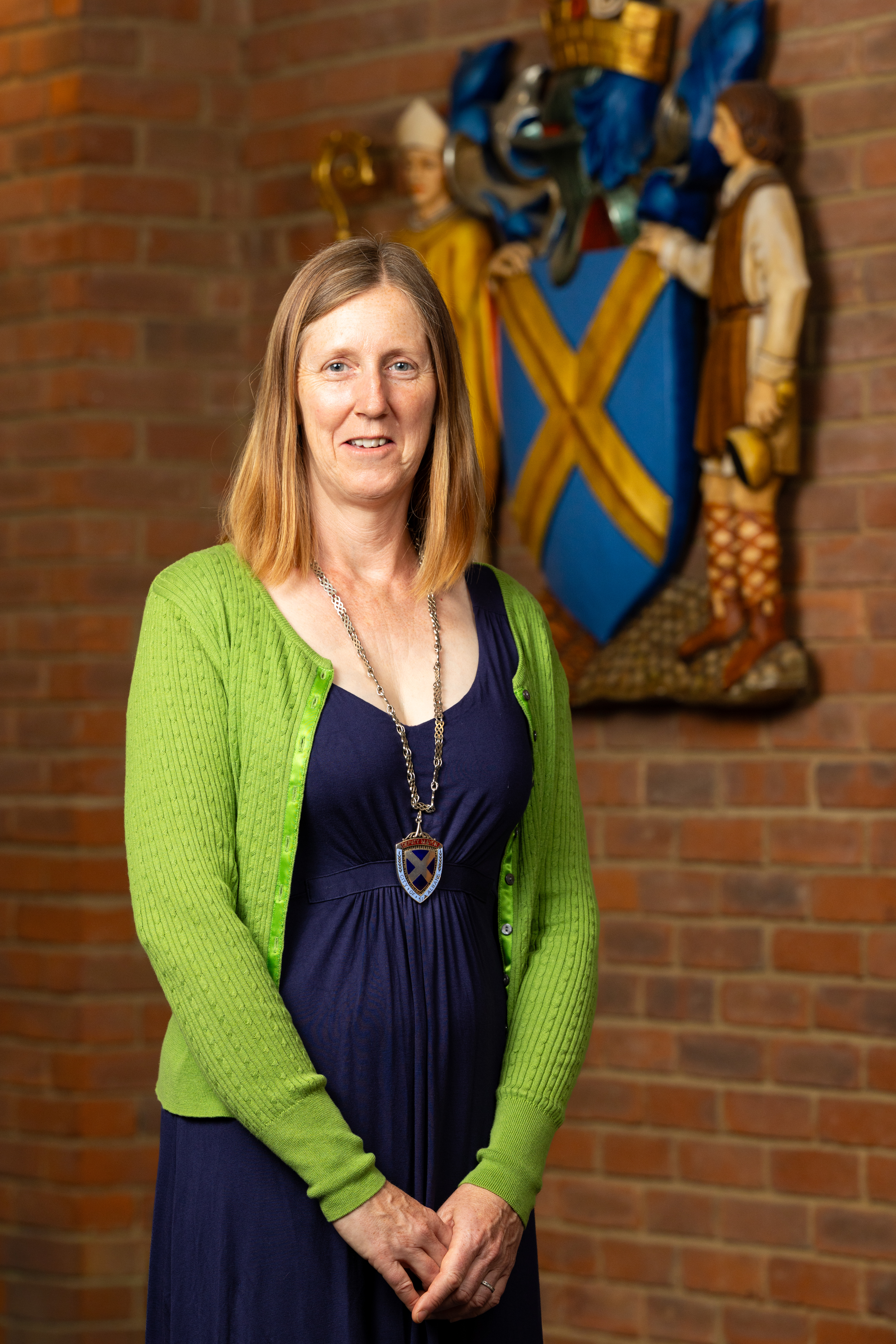
Juliet has been a District Councillor since 2023 and represents the St Peters ward.
Born In Croydon, her childhood was spent in West Wickham, Kent, before she graduated from Swansea University with a BA in English Literature and Latin.
She has lived in St Albans for 20 years, initially working as a project manager, and is married to Darren with whom she has three boys.
When her children were young, she retrained to become a childminder so that she could be at home with them.
Juliet was a long-standing member of St Michael Primary School’s PTA and is passionate about the need to care for the environment.
She has campaigned with the pressure group Greenpeace since she was 15 and runs the local branch.
Juliet also monitors wildflower areas for Butterfly Conservation, helps with community garden projects, assists with a local bike bus scheme and organises community litter picks.
She enjoys beekeeping, working on her allotment, cooking plant-based food and walking her “crazy spaniel” Luna.
Mayor’s Events Toggle accordion
We maintain a diary of public events and appointments that have been attended by the Mayor. If you would like to invite the Mayor to an event you are managing, please use our contact form to make your request. Please note that the diary below is no guarantee of the Mayor's availability in the future.
Invite the Mayor to an event Toggle accordion
If you would like to invite the Mayor to a function or event, please contact:
The Mayor’s Parlour
District Council Offices
St Peter’s Street
St Albans
Herts.
AL1 3JE
Email: mayoralty@stalbans.gov.uk
Tel: 01727 819544
Please download an invite form or use an eForm
Mayor's Charity 2026-27 Toggle accordion

Youth Talk provides free counselling to young people, aged 13 to 25, throughout the District to help improve their mental health and wellbeing. You can find more information about them here.

St Albans Sea Cadets helps young people experience a wide range of activities such as sailing, windsurfing and rock climbing to give them confidence and prepare them for later life. More information is available here.
History of the Mayoralty
The area now known as the City and District of St Albans was originally home to the Celtic Catuvellauni tribe. Their capital was at what is now Wheathampstead, which eventually fell under their leader, Cassivellaunus, to Julius Caesar in 54 BC. Within a century, the Roman colonisers had settled in what would be Verulamium, the third largest Roman town in Britain. Verulamium, now St Albans, was located a day’s march or a half day’s coach ride from London, making it an essential hub for travel to the north along Watling Street, now on the A5.
You can find out more about the history of the City and District at St Albans Museum + Gallery and Verulamium Museum.
The Church
Saint Alban, a Roman-British official who had converted to Christianity, was most likely martyred c. 250 AD, becoming the first British Saint. The site of his burial, as with many saints, became a place of pilgrimage for common people and nobles alike.

(Above: A depiction of the murder of St Alban. From Ralph of Dunstable, William of St Albans, Matthew Paris (early 13th-century), p. 82. Courtesy of Trinity College Dublin, University of Dublin https://digitalcollections.tcd.ie/concern/works/8p58pm63q?locale=en)
A Benedictine monastery was founded and dedicated to St Alban in 793 AD. After the Norman Conquest in 1066 Paul de Caen became the Abbot and he oversaw the rebuilding of the Abbey church. The Abbey was consecrated in 1115 in a ceremony attended by King Henry I and Queen Matilda. Ironically, the only British Pope, Adrian IV, was denied acceptance into the Benedictine Order at the Abbey in 1154. The Abbey ceased its functions in 1539 during Henry VIII’s Dissolution of the Monasteries. The Abbey church continued to be used as a parish church by local residents and in 1877 it became a Cathedral for the newly formed Diocese of St Albans.
Every June the city celebrates St Albans Day with a large pilgrimage including giant puppets and colourful costumes. The procession travels through the centre of the city and finishes at St Albans Cathedral.
The Battles of St Albans
St Albans saw decisive battles in the War of the Roses, a thirty-year power struggle between the houses of York and Lancaster. This feud ultimately ended with the foundation of the Tudor Dynasty by the Lancastrian Henry VII’s seizure of power at the Battle of Bosworth in 1485, and subsequent marriage to Elizabeth of York.
The two Battles of St Albans took place in 1455 and 1461. The first enabled Henry VI’s kidnap, the second proving decisive in the coronation of Edward IV. Many road names around Bernard’s Heath reference these major historic events, including Archers Field, Battlefield Road, and Lancaster Road. As in Roman Britain, St Albans has consistently proved itself to be a strategically important stronghold as a site of battle, of trade, and of piety.
The City and the Mayor
St Albans received city status in 1877 by Royal Charter issued by Queen Victoria. “The Right Worshipful” was added to the title of “The Mayor” which henceforth made the Mayor of St Albans the senior Mayor in Hertfordshire.
St Albans has had a Mayor for over 450 years, the first being John Lockey who came to office after the town was granted a Royal Charter in 1553. During their tenure, the Mayor is the first citizen of St Albans. Some tenures have been cut short by the outbreak of war and death in office, whilst others have served for three consecutive years, as with William Balcombe Simpson, who served 1860-1862. Other famous St Albans Mayors include Samuel Ryder (1858-1936), known for giving his name to the Ryder Cup tournament.

(Above: Samuel Ryder in Mayoral garb, 1905. Courtesy of St Albans Museums’ Collections https://collections.stalbansmuseums.org.uk/objects/51465)
Originally, the Mayor chosen by burgesses and mayors originally held Executive and Judicial Roles, unlike today. Today’s mayoralty is ceremonial, with the central role being focused on representing the City and District Council locally, nationally, and internationally.
The official mayoral garments include a Chain of Office, red gown, and black tricorn hat. When wearing these the mayor is proceeded by a Mace Bearer carrying a silver-gilded mace, walking three steps ahead to protect the mayor. The last time the mace bearer needed to protect the mayor was during the Poll Tax protests in 1990.

(Above: St Albans City and District Coat of Arms, courtesy of St Albans Museums)
The City’s Coat of Arms displays a yellow cross on a blue background – the Coat of arms of the former Abbots. The three figures reference the medieval equilibrium: the Bishop, the Knight and the Labourer or Peasant. Here, the labourer is a printer, standing on cobbled ground of the medieval town. The bishop stands on ploughed land, symbolising the importance of agriculture in the area.
The process for selecting the mayor involves using a formula that ensures each political group has a proportional share of the honour of nominating councillors to be Mayor and Deputy Mayor.
Armorial Bearings Toggle accordion
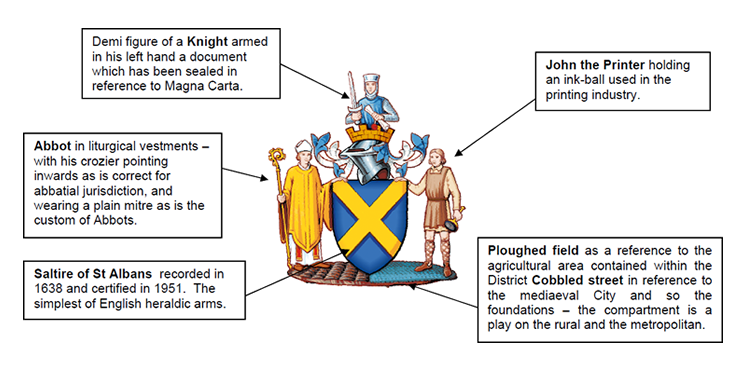
The Crest may be taken as allusion to the meeting of the barons in St Albans Abbey prior to Magna Carta. The crest shows a demi figure of a knight armed according to the period concerned and in his left hand he holds a document which has been sealed about Magna Carta. The crest arises from a mural crown – frequently employed to indicate municipal entities of real importance such as Cities.
The Supporters refer to the Abbey by way of having an Abbot in liturgical vestments – with his crozier pointing inwards as is correct for abbatial jurisdiction and wearing a plain mitre as is the custom of Abbots. The other Supporter may be taken as allusion of John the Printer dressed as for the period and holding in his hand an ink-ball – an instrument used in printing. Both supporters stand on a compartment which is divided up in the centre and which has to the left a ploughed field as a reference to the agricultural area contained within the District, and on the other side a cobbled street in reference to the mediaeval City and so the foundations, as it were, of the present City – the compartment is a play on the rural and the metropolitan.
Mayoral Roll Toggle accordion
There have been 482 Mayors. These are recorded on vellum rolls and are displayed outside the Council Chamber at the Council Offices in the Civic Centre. Our most recent mayors are detailed below.
Honorary Aldermen Toggle accordion
Current Honorary Aldermen:
Alderman Annie Brewster
Alderman Peter Burrows
Alderman Sheila Burton
Alderman Alec Campbell
Alderman Susan Carr (Cowan)
Alderman John Chambers
Alderman Daniel Chichester-Miles
Alderman Geoff Churchard
Alderman Janet Churchard
Alderman Gill Clark
Alderman Tom Clegg
Alderman David Coe
Alderman Maxine Crawley
Alderman Julian Daly
Alderman Sue Featherstone
Alderman Chris Flynn
Alderman Paul Foster
Alderman Martin Frearson
Alderman Katherine Gardener
Alderman Salih Gaygusuz
Alderman Dreda Gordon
Alderman Eileen Harris
Alderman Geoff Harrison
Alderman Martin Leach
Alderman Aislinn Lee
Alderman Frances Leonard
Alderman Joyce Lusby
Alderman Malcolm Macmillan
Alderman David McManus
Alderman Roma Mills
Alderman Michael Morrell
Alderman Kate Morris
Alderman Chris Oxley
Alderman Mal Pakenham
Alderman John Peters
Alderman Brian Peyton
Alderman Kerry Pollard
Alderman Rob Prowse
Alderman Robert Ransted
Alderman Beric Read
Alderman Andrew Rose
Alderman Pat Schofield
Alderman Janet Smith
Alderman Alison Steer
Alderman Jennifer Stroud
Alderman Melvyn Teare
Alderman Geoffrey Turner
Alderman Ron Wheeldon
Alderman Chris White
Alderman Chris Whiteside
Alderman Sandra Wood
Alderman Nigel Woodsmith
Alderman David Yates
Alderman Iqbal Zia
Town Twinning
We are twinned with several towns.
Exchanges are often organised either by the friendship association for each town, or by schools or voluntary organisations.
The Council of European Municipalities and Regions can provide further information on Town Twinning in Europe and potential funding opportunities.
Our Twin Towns
Alzey, Germany Toggle accordion
Alzey is the German twin town of Harpenden. It is a small bustling market town not far from Mainz in the middle of the Rheinhessen wine-producing area. A Wine Festival is held in Alzey in September each year and is very popular. The two towns have been twinned since 1963. The 25th anniversary of the twinning was marked by the planting of an oak tree in Harpenden and the placing of a bench on the Common.
Boissy and St. Yon, France Toggle accordion
Colney Heath has been twinned with Boissy and St. Yon for several years. Boissy is about twenty miles south of Paris, in the department of Essone. The smaller village of St. Yon is very close by. Both communities are surrounded by arable land, but many of the local residents commute to work. The square in Boissy is dominated by the Maire and contains a large church and several small shops. There are many sports and social activities there, with clubs for all ages including cycling, boules, moving images, Esperanto, twinning and mushroom growing!
Cosne-Cours-sur-Loire, France Toggle accordion
The French twin town of Harpenden. It is a market town about forty miles north of Nevers- St. Albans’ French twin- and it is on the same rail link from Paris. Nearby are the wine areas of Sancerre, Pouilly and the latest appellation controle in Cote de Genoux. Cosne is also the center of wine quality testing in the area.
Harpenden has two small roads named after the area- Cosne and Loire Mews, while Cosne has a small amenity area near the center of its town called Jardin d’Harpenden.
Fano, Italy Toggle accordion
The link between the two towns was established in 1998. Fano has an important Roman heritage, which gives it an obvious link with the City and District of St Albans. Fano is a resort town on the east coast of Italy, close to Rimini and Ancona, which have airports for easy access. It has two beautiful beaches and is a fishing port with a colourful harbor. A Carnival is held over several weekends in February each year, where sweets are thrown from floats to the enthusiastic crowds.
HMS St Albans Toggle accordion
The City & District of St Albans has formed friendship links with the HMS St Albans. On 18th July 2004, the Mayor granted the Freedom of the City to the ship’s company at a special ceremony.
HMS St Albans (F83) is a Type 23 ‘Duke’ Class frigate of the Royal Navy. She was the 16th and final ship of the class and is the sixth ship to honour the Duke of St Albans. She was launched from the BAE Systems yard on the River Clyde in Glasgow, on 6th May 2000.
Nevers, France Toggle accordion
The link with Nevers was established in 1974. Nevers was chosen as it is a city with physical and historical similarities with St Albans and is in the Burgundy region of France which has a long, ‘historical’, link with Hertfordshire County Council.
Nevers is in the heart of Burgundy and is a cathedral city, with a history dating back to Roman times. It is a place of pilgrimage, being the resting place of St. Bernadette. Nevers is also famous for its distinctive earthenware and glassware and is the venue for the French Grand Prix.
Nyíregyháza, Hungary Toggle accordion
A friendship link was created with Nyíregyháza in 1994, following a decision by the City and District Council to create a link with an Eastern European country following the collapse of the Berlin Wall. The link was upgraded to a full town twinning in 1996.
Nyíregyháza is situated in the north east of Hungary and is the county town of the region. It is not too far from the boarders of Romania and the Ukraine. The name of the town first appears in 1326.
Nyíregyháza is the seventh largest town in Hungary, with a population of about 120,000. It is a town with a large population of young people. The Sóstó spa is a beautiful parkland area with an outdoor country museum and a zoo and receives many visitors each year.
Odense, Denmark Toggle accordion
The twinning link between the City and District and Odense began in 1948 when representatives from Odense were invited to attend the St Albans Pageant at the suggestion of Count Scheel, a citizen of Odense who had lived in St Albans for many years. The historical connection between the two cities began when King Canute was said to have taken to Denmark an arm of Saint Alban, who was executed in AD303. There is also a church of St Alban in Odense and a large brewery producing Albani Beer.
Odense is the main town on the island of Funen and is the third largest city in Denmark, with a population of over 170,000 people. It is the birthplace of Hans Christian Andersen. The city celebrated its Millennium in 1988.
Sylhet, Bangladesh Toggle accordion
There is a friendship link with the Sylhet region of Bangladesh rather than full town twinning. A friendship link is less formal and is community led. The link was established in 1988 when the District Council supported a housing project in Sylhet as part of the International Year of Shelter for the Homeless. Sylhet was chosen because it is the area of origin for the largest ethnic minority group in St Albans.
Sylhet is in the north east of Bangladesh and is the second largest economically prosperous area in the country. There are famous tea gardens connected with Asam and Darjeeling tea. The Mausoleum of Shah Jalal and Shaheed Minar are of historical significance.
Worms, Germany Toggle accordion
Worms lies on the Rhine, south of Frankfurt, and is the oldest city in Germany. With a population now of 80,000, it has a Celtic and Roman heritage, but takes special pride in its medieval history, having been the location for much of the anonymous saga of the Nibelungen. A statue of the legendary Hagen stands on the banks of the river, the treasure held high above his head, before it is hurled into the river. Worms was also the location of the famous Diet in 1521 where Martin Luther defended his doctrines.