


Butterfly population in wilding areas in St Albans District has increased by 350% in past three years
The butterfly population of parts of St Albans District has increased by 350% in just three years thanks to a major wilding programme.
Forty key grassland sites across the District have been seeded with wildflowers and mowed only once in the late summer to boost biodiversity.
St Albans City and District Council, Herts and Middlesex Wildlife Trust, Butterfly Conservation and several other organisations have carried out the project.
A report by Butterfly Conservation into the results of the initiative in 2025 shows that:
- Sightings of butterflies during site visits were up by an average of 80% on 2024 and 350% on 2022.
- Twenty-three different butterfly species were recorded this year with Meadow Brown being the most common followed by Small White and Large White.
The total number of butterfly sightings was 1,509 across all sites with an average of 12.9 seen per visit.
The Wilder St Albans project is one of the actions the Council has taken to improve the local environment since declaring a climate emergency six years ago.
Butterflies are a key indicator of the health of the environment as they are pollinators and help flowers, fruits and vegetables reproduce. They also provide a vital food source for birds and other wildlife.
Their presence is an indicator of a strong ecosystem while their decline points to ecological problems.
Councillor Paul de Kort, the Council’s Leader, said:
Wilder St Albans is one of the most imaginative projects the Council has undertaken to improve biodiversity.
It has been hugely successful as is revealed by these startling increases in butterfly numbers. I am sure our residents will be delighted with these figures which show that we are creating healthier environments within our communities.
The project to wild areas across the District is now well established and we are extending it with a number of other sites being included in next year’s programme.
We have worked on this project with several key partners, including Butterfly Conservation and the Herts and Middlesex Wildlife Trust. Our thanks go to them and the many volunteers who have helped with the butterfly count.
The wilding sites are spread across the District and include parts of Verulamium Park, Cunningham Fields, The Wick, London Road Cemetery, Victoria Playing Fields and Camp Open Space in St Albans.
Also on the list are Cotlandswick, London Colney; Derwent Road Open Space and Alzey Gardens, Harpenden; Lybury Lane, Redbourn; and Caesar’s Road, Wheathampstead.
Volunteers from Butterfly Conservation, Ver Valley Society and Wilderhood Watch carried out the butterfly recording.
Four visits to each site were made at monthly intervals between May and August this year. Each visit was required to take place for 20 minutes in sunny weather.
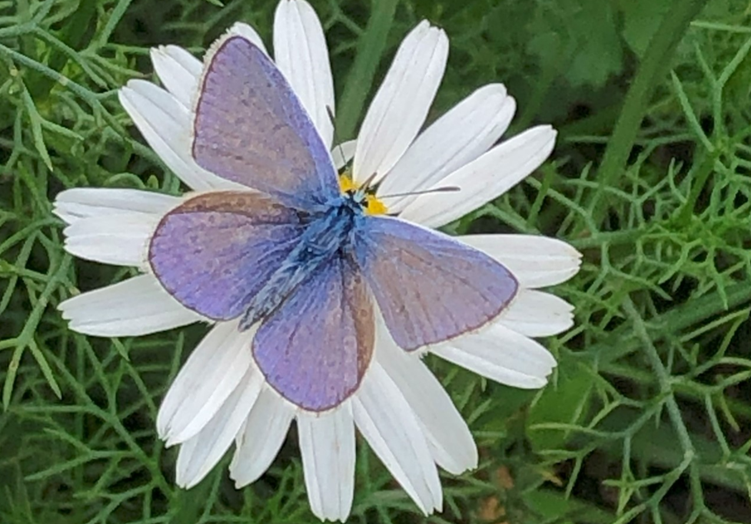
The number of most of the 23 species had more than doubled since last year with 65 Common Blues recorded, up from just one in 2024. A Purple Hairstreak was spotted for the first time.
The Big Butterfly Count which takes place nationwide every year has shown a 15% increase in butterflies since 2022.
This means that the increase in numbers at the District’s summer meadow plots has at 350% been 23 times greater than the national average.
Among the other groups involved with the project are Hertfordshire County Council’s Countryside Management Service and John O’Conner Grounds Maintenance
Several additional sites for the project have been identified and were seeded in the autumn. These include the former Abbey View Golf Course in Verulamium Park, Crabtree Fields, Harpenden, and Nicholls Close, Redbourn.
Malcolm Hull, of Butterfly Conservation, who wrote the report said:
Butterflies are in trouble, numbers have fallen and we have lost 25% of the species which used to live in St Albans District.
The results of this year’s count show that the Council’s approach is working to help numbers recover.
Reducing mowing and creating wildflower meadows creates more places for butterflies and other wildlife to live and thrive. People can try the same approach in their gardens and see the results.
Photo by Malcolm Hull: a Common Blue butterfly spotted at one of the summer meadow sites.
Media contact: John McJannet, Principal Communications Officer: 01727- 819533; john.mcjannet@stalbans.gov.uk.