

Energy efficiency
How we power and heat our homes has a direct impact on the climate and pollution. By improving home energy efficiency and using energy more mindfully we can save money on our bills, whilst keeping our homes comfortable and reducing our impact on the environment.
This page provides information on sources of funding and advice for energy efficiency and managing your energy bills. We recommend contacting the St Albans Home Energy Support Service for all your energy bill or energy efficiency enquiries.
Please note: The Council will never visit your home unannounced so be aware of anyone cold calling your home stating they are offering energy efficiency measures on behalf of the Council. Should we need to visit your home, we would always provide notice in advance and would provide legitimate identification. If you are approached by a company offering you a grant, you should check their legitimacy before committing to any works.
St Albans Home Energy Support Service Toggle accordion
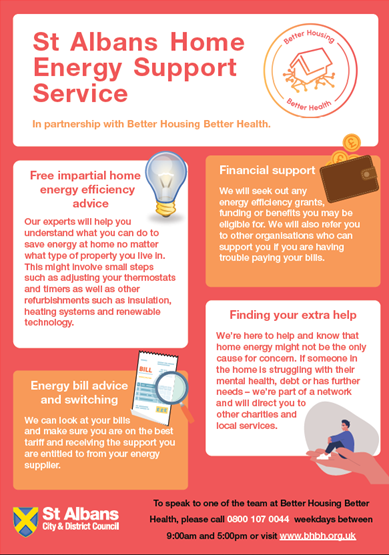 This service, which is available to all St Albans District households regardless of income, is provided in partnership with Better Housing Better Health.
Through this service you can obtain the following:
- Information on grants and funds you may be eligible for
- Checks to make sure you are receiving all the support from your energy supplier that you are entitled to
- Advice on switching suppliers
- Detailed advice on how to save energy at home
- Debt advice
- Referral to other organisations or contractors who may be able to help you
- Detailed home energy assessments
Please contact:
0800 107 0044 (weekdays 9am-5pm)
Funding for Energy Efficiency Toggle accordion
There may be grants and support available to help householders wanting to improve the energy efficiency of their homes or receive advice on funding.
Please contact:
St Albans Home Energy Support Service - 0800 107 0044 (weekdays 9am-5pm)
All St Albans District Households can access:
- Checks to assess your eligibility for local grants and funds (including all of the funds listed below)
- Help to ensure you are receiving all the support you are entitled to
- Advice on switching suppliers
- Personalised advice on how to save energy at home
- Debt advice
- Referral to other organisations or contractors who may be able to help you
Warm Homes Local Grant: This scheme is being delivered to households in the St Albans District, in partnership with the National Energy Foundation. Eligible households can receive fully funded energy efficiency improvements worth up to £30,000 per home. Measures may include wall, loft and underfloor insulation, heating controls, draught-proofing, double or triple glazing, solar photovoltaic panels, and heat pumps. More details on how to apply are available on our dedicated webpage here.
Boiler Upgrade Scheme: Through the Boiler Upgrade Scheme, households and small businesses may be eligible for up to £9,000 towards the cost of replacing their heating system with air or ground source heat pumps. Full advice is available here. Guidance for property-owners and guidance for installers is available from Ofgem.
Older People’s Trust: If you are over 60 and need help to stay warm in your home or manage your fuel bills, the Older People’s Trust may be able to help you. We recommend you contact the St Albans Home Energy Support Service (as above) for boiler enquiries first and contact the Older People’s Trust directly for anything else. The Older People's Trust provides free boiler servicing for those meeting their criteria.
Energy efficiency help for Voluntary Community and Social Enterprises: The VCSE Energy Efficiency Scheme is offering independent energy assessments to help voluntary, community and social enterprise organisations (VCSEs) identify energy-saving opportunities for their buildings. From January 2024, the scheme will also be offering capital grants to implement measures recommended by these assessments. The scheme is funded by the UK Government and administered by Groundwork. Applicant organisations must be a VCSE based in England and delivering frontline services. More information can be found here.
Oil Bulk Buying Group: If you heat your home with oil you could save money by joining a bulk buying group. You can find out more by visiting the Community Development Agency for Hertfordshire (CDA Herts) website.
Making your home energy efficient Toggle accordion
There is a wealth of information available on how to make your home more energy efficient. This is also called Retrofitting.
Free guides to home energy efficiency or home retrofit:
- Hertfordshire Sustainability and Climate Change Partnership have produced a detailed guide on how to retrofit your home. The guide covers quick wins you can make as well as bigger changes, for all the different building types.
- Judith Leary, a local author, has produced this Stay Warm for Less booklet and blog where she describes how she reduced the energy consumption of her St Albans home by 75% and provides tips on how you can to.
- St Albans Citizens Advice have produced The Cost Saving Tips Booklet which is filled with ideas on how to saving energy.
Monitor your energy consumption:
- Read your meter regularly to ensure your bills are accurate and up to date and to enable you to switch supplier easily. If you are not sure how to read your meter there is help available here, or you can ask your supplier to do it for you. You should keep a record for yourself and send a copy to your energy supplier regularly.
- Borrow a smart meter: Residents of St. Albans District can borrow a smart meter for free three-week loan from any of the libraries. These allow you to monitor your real time energy use and are a great educational tool. Why not see which of your appliances are using the most energy? Or try switching everything off to find hidden energy use.
- Install a smart meter: Energy suppliers may offer you a smart meter which allows the energy supplier to access your meter readings so that any bills that are issued to you are accurate. More information about smart meters can be found here.
Make sure your home is insulated:
An uninsulated house will lose around 60% of its heat through the roof and walls. Insulation is a vital first step in making your home more energy efficient. There may be financial assistance to help you.
- Sustainable St Albans offer free loans of a Thermal Imaging Camera so you can identify where energy is leaking from your home. For more information please visit their website here.
- Loft: Ensure you have at least 27 cm of insulation (UK minimum standard).
- Cavity walls: Post 1920's most homes were built with external cavity walls. This means there is an air gap between the inner and outer walls which can be very easily filled.
- Floorboards: Many newer homes have a ground floor made of solid concrete which may be insulated with a solid insulation board on top. Older homes are more likely to have suspended timber floors which can be insulated by laying mineral wool insulation beneath the floorboards. Care should be taken to ensure you don't block under-floor air bricks as floorboards may rot without adequate ventilation.
- Windows and Doors: If you can't afford double glazing, you can invest in secondary glazing or thick, thermally lined curtains to keep the heat in. Don't let curtains hang in front of the radiators though otherwise the outside wall will benefit from the heat instead of the room. Use draught proofing strips around the frame, brush strips work better for sash windows. Gaps around doors can be sealed by fitting draught-proofing strips around the edges, brush on the bottom, and hinged draught excluders on the letter box.
- Fireplaces: If you don't use your fireplace, it is probably a source of unnecessary draughts. You can fit a cap over the chimney pot or buy an inflatable draught excluder to fit within the chimney, which can easily be removed if you decide to use the fireplace again in future.
- Solid walls: Before the 1920's most homes were built with solid walls. The only way to insulate these is by fitting insulation to the inside or outside of the wall. This is an expensive measure but there could be financial assistance to help you. Solid wall insulation could save around £450 per year in energy costs.
Take control of the heating
- Upgrade your boiler: By replacing an old boiler with a new, condensing boiler, you could lower your energy bills by up to £300 a year. You may be eligible to receive financial support to help you.
- Install a heat pump:
- Room thermostats monitor warmth in specific rooms and adjust the boiler operations accordingly. Your room thermostats should be set to your lowest comfortable temperature, typically 18-21 ºC. You don't need to turn your thermostat up when it is colder outside as the house will still be heated to the same temperature(although it might take a bit longer to warm up on colder days). Programmable room thermostats allow you to set different temperatures for different times of the day.
- Thermostatic radiator valves reduce the flow of water through the radiator. You can set each one to the level you want for the room, using less energy for a lower flow of water. If you have electric heating, visit the Energy Saving Trust website for information on how to get the best from your heating controls.
- Temporary electric heaters are very expensive and inefficient to run but if you need temporary, instant heating then it's important to choose the most efficient version. Fan and halogen (glow) heaters heat the air in front of them quickly and are good for short blasts of heat. However, the room will quickly cool down once they are turned off. Oil-filled radiators and convection heaters heat the air more slowly but are better at heating the whole room and are best suited for rooms which are used for long periods.
Lighting
- Install all LED lighting: Replace all your lighting with LEDs and you could save around £30 per year. Although more expensive initially, they use far less energy and also last much longer so they will save you money in the long term.
Hot water
- It's easy to forget the connection between our water and energy use. By reducing the amount of hot water you use, say by shortening your showers or cutting down on baths, you will save money on your energy bills. Make sure you set your boiler controls so that you only heat the water when you need it and not when you don't.
- Tank Jacket: Hot water cylinders should be fitted with a tank jacket. These are relatively cheap and could save you £50 each year on your energy bill, or even more if you have electric water heating. It's also a good idea to insulate the hot water pipes connecting your heating system if they are not yet insulated.
Appliances
- Check the running costs of your appliances: Our homes are filled with more and more electrical items but most of us have no idea how much it costs to power them all. The Sust-it website allows you to check the running costs of thousands of electrical products. This is useful when you are shopping for a new appliance but also to help you understand how much your existing electrical products cost to run. Look out for products marked with the Energy Saving Trust recommended logo as these are the most energy efficient products on the market.
- Avoid stand-by: UK households waste £227M a year by leaving electrical appliances on standby. You could save around £36 a year simply by turning appliances off at the plug when not in use. If you can't physically reach all your plug sockets to turn things off, it might be worth investing in remote control plug sockets, which can be ordered online for around £10 each (or cheaper when bought in sets).
Heat Pumps: What you need to know Toggle accordion
A heat pump is an energy efficient low-carbon heating system that captures heat from outside and transfers it to your home.
There are many different types of heat pump, the two most common types are air source heat pumps and ground source heat pumps.
Air source heat pumps (ASHPs) absorb heat from the air whereas ground source heat pumps (GSHPs) absorb heat from the ground. Once heat is absorbed from the environment (the air or the ground), it is transferred to a fluid, which is then compressed to increase its temperature. This heat is then transferred from the compressed fluid into your home’s central heating system (in an air-to-water or ground-to-water heat pump), or passed into hot air blowers (in an air-to-air heat pump).
Benefits:
- Heat pumps produce around 3 to 4 units of heat for every unit of electricity consumed, making them up to 4x more efficient than gas or oil boilers
- As heat pumps run on electricity instead of burning fossil fuels, they have a lower environmental impact. They can emit up to 70% less carbon dioxide over 15 years compared to gas boilers
- With an average lifespan of 20 years, heat pumps often last longer than traditional gas boilers
- Air-to-air heat pumps can provide both heating during winter and cooling (air conditioning) during summer.
- If you are using oil, Liquefied Petroleum Gas (LPG) or electric heating, you could see a reduction to your energy bill if you switch to a heat pump.
Funding:
If you are eligible for the Council’s Warm Homes Local Grant, you could get a heat pump (and other energy-saving home upgrades) for FREE.
The government’s Boiler Upgrade Scheme offers property owners up to £9,000 towards the cost of replacing fossil fuel heating systems with heat pumps.
Guidance for your home:
Heat pumps are especially suited to homes that are already well insulated, are off the gas-grid (using electric storage heaters, oil, liquefied petroleum gas, or coal to heat a home), or those with old heating systems needing replacement.
- Check if your home is suitable for a heat pump: https://www.gov.uk/check-heat-pump
- Prepare your home for a heat pump before your boiler breaks – view our checklist here.
- Visit a Heat Pump (free service provided by the charity Nesta), connects you with local people who already have a heat pump. This gives you an opportunity to get first hand experience of what it's actually like to live with, see and hear the unit for yourself, and ask an owner anything: visitaheatpump.com
Switch your energy supplier Toggle accordion
Shopping around for the best deal can help save you money on your energy bills and switching tariff or energy supplier is easier than you may think. Don't forget to switch every 2 years.
- Always use an Ofgem accredited switching service
- Citizens Advice St Albans can help you find the cheapest tariff and even have their own electronic price comparison service.
- Which? provide a good range of information and advice on finding the best tariffs.
Support towards your energy bills Toggle accordion
Your household energy bill is made up of a number of elements. The largest proportion of your bill is made up of wholesale energy and supply costs, which are forecasted to increase in the future. You can minimise how much you pay for your energy by ensuring you are on the best tariff for your needs and if you meet certain criteria, you may be eligible to receive financial support from the Government or your energy supplier.
If you are having trouble paying your bills: Your energy supplier is obligated to help you find a manageable way to pay for your bills or any debt that has accrued. You should contact them in the first instance. Citizens Advice consumer helpline can be contacted for support on 08454 040506.
Get help to understand what benefits you may be entitled to: The benefits system is complex so it's a good idea to get some help to make sure you are the benefits you are entitled to. You may wish to make an appointment to speak to Citizens Advice St Albans.
Winter Fuel Payment: If you were born on or before 5th January 1953, you are eligible for the Winter Fuel Payment, to help towards your heating bills. This tax-free payment of between £100-£300 is usually paid between November and December. You can find out more by phoning the Department for Work & Pensions helpline, on 0845 915 1515.
Cold Weather Payment: If you receive certain benefits, you are eligible to receive a Cold Weather Payment if the temperature in your area is recorded as, or forecast to be, 0oC or lower for 7 consecutive days between 1 November and 31 March. The payment is £25 for each 7 day period of cold weather. If you are eligible, you should be paid automatically. If you think are eligible but don't receive your payment, you should contact your pension centre or Job Centre Plus.
Warm Home Discount: You could be eligible for a one off discount on your electricity bills from your supplier, under the Government's Warm Home Discount (WHD). Most energy suppliers offer assistance to households on means-tested benefits or with children under the age of five. It’s worth checking with your supplier to see if you are eligible.
Priority Services Register (PSR): If you are a pensioner, have a disability or a long-term health condition, you can sign up to your energy supplier’s Priority Services Register to get extra help and support with your energy supply. Contact your energy supplier directly, to see if you are eligible. Benefits include:
- Protection from bogus callers through a password protection scheme
- Regular meter readings
- Special communication services for those with hearing and visual impairments
- Bill nominee scheme
- Advance notice of supply interruption (important if you rely on medical equipment or a stair lift)
- Priority services in an emergency
- Annual gas safety check
Checking Tradespersons Toggle accordion
The trades person responsible for the work should be part of an accreditation body that maintains industry standards. You may wish to check that they are registered with such an organisation. If you have had an energy efficiency measure installed and have a complaint about the installation, you can also contact one of these accreditation bodies to complain. These are some of the organisations involved with accrediting installers (although note that there are others out there):
- Gas Safe Register
- National Insulation Association
- Cavity Insulation Guarantee Agency
- Solid Wall Insulation Guarantee Agency
The Government have published consumer advice on buying green heating and insulation here.
Reporting a problem: If you wish to report a problem with a trades man you can also contact the Citizens Advice consumer helpline on 08454 04 05 06. They may be able to provide assistance and they can also refer matters to Trading Standards.
What is the Council doing to help reduce energy use? Toggle accordion
The Council aims to support local households to reduce their energy consumption, whilst keeping warm. The actions we are taking, along with our work to reduce energy from our own estate, are included to our Sustainability Strategy and Climate Crisis Action Plan.