

Renewable energy
Renewable energy, generated from natural resources such as wind, water, sun and biomass, have the potential to supply 100% of the UK’s power.
They are non-polluting and are in limitless supply thereby providing us with a sustainable option for our future energy needs.
Solar Power: What you need to know Toggle accordion
Contrary to popular belief, solar PV panels do not require direct sunlight to generate electricity and are therefore suitable in our northern climate. Many systems allow the householder to connect a two-way meter so that any excess electricity can be sold to the grid. Batteries can be installed at the same time or separately. Many households start with solar panels and add a battery later — others choose to install both at the same time for maximum benefit.
Installing solar panels on your home is one of the most effective ways to cut energy bills, increase energy independence and future‑proof your property. Thousands of households across the St Albans District already have rooftop solar, and uptake is growing.
Typical installation journey:
- Check whether your roof is suitable
- Check how much electricity your household uses
- Confirm planning rules (often no permission needed)
- Consider whether to add a battery if budget allows
- Get quotes from MCS-certified installers
- Look out for group-buying opportunities such as Solar Together Hertfordshire
Most households complete the process in a few weeks.
Why consider solar panels? Solar panels can help you to:
- Reduce electricity bills
- Protect yourself from energy price rises
- Power an electric vehicle more cheaply
- Increase your home’s value and future-proof it
- Solar works well on most owner-occupied homes with a clear roof, especially detached and semi-detached properties.
Adding a battery provides numerous benefits:
- Use more of the electricity your panels generate
- Reduce reliance on the grid in the evening
- Make better use of smart electricity tariffs
- Increase resilience during power cuts (with suitable systems)
- Without a battery, surplus solar electricity is exported to the grid during the day.
Installing the solar panels and battery at the same time brings further benefits:
- Increase bill savings
- Reduce installation costs compared to adding later
- Simplify wiring and equipment choices
- Make your home ready for EV charging or a heat pump
- Many households choose this option if budget allows.
If you plan to add a battery later, tell your installer so the system is designed to be expandable.
What are the costs?
Typical costs vary depending on system size and whether you include a battery. There are online calculators available to help you estimate the costs and payback of a solar PV system for your specific home, an example is www.fmb.org.uk/homepicks/solar-panels/cost-of-solar-panels. Note that:
- There is no VAT on domestic solar and batteries
- Solar-only systems usually have the lowest up-front cost
- Batteries increase savings but add to initial costs
- Installers should provide clear estimates of total costs, savings and payback periods.
Smart Tariffs:
Households with solar and batteries often use:
- Smart export tariffs, paying for surplus electricity
- Time-of-use tariffs, charging batteries when electricity is cheaper
- Tariffs change regularly. Your installer or energy supplier can advise.
How do I find an installer? The Council does not recommend individual installers, but you should:
- Use an MCS-certified installer
- Get at least three quotes
- Ask about warranties and aftercare
- MCS certification protects consumers and is required for export payments.
Do I need planning permission?
In most cases, planning permission may not be required for domestic solar panels.
Panels are usually classed as permitted development if the panels do not project more than 200mm from the roof and are installed to minimise visual impact, however there are additional considerations for listed buildings or those in conservation areas. Please see the section on Planning Permission.
Solar Together Toggle accordion
Solar Together Hertfordshire
In previous years, St Albans City and District Council has partnered with independent group-buying experts, iChoosr Ltd. to bring this opportunity to St Albans District homeowners. There is currently no live scheme however you can register your interest in future schemes here: www.solartogether.co.uk/st-albans/home
Solar Together is a group-buying scheme which brings local households together to obtain renewable energy at competitive prices, helping you through the process and keeping you informed at every step of the way.
If you already have solar panels installed, you can also register to have battery storage added to maximise the benefits of the system.
How it works:
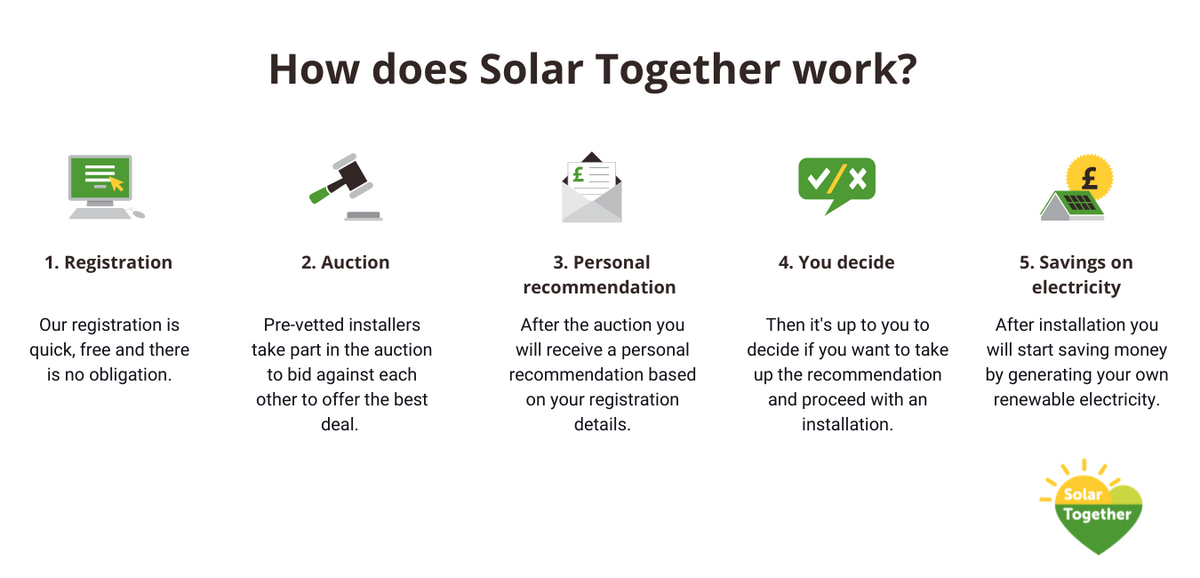
- When the scheme opens, households are invited to register for the scheme until the published deadline. It's free to register and there is no obligation to go ahead with installation.
- Pre-approved UK Solar PV installers will then participate in a reverse auction. They will be able to offer competitive pricing as the volume and geographic concentration makes it possible for them to realise greater efficiencies, which they pass on as lower cost installations.
- After the auction, registered households will be emailed a personal recommendation and price based on the information they provided. Households then have six weeks to accept the offer.
- Once accepted, the specifics of the recommendation will be confirmed with a technical survey. Acceptance closes by a specified date.
- A date will be agreed for the installation.
Planning requirements for renewable technology Toggle accordion
The planning rules have been simplified to make it easier for those wishing to install renewable technology. Please refer to the Planning Portal website for information on the rules.
Special considerations are likely to apply to listed buildings or those sited within the green belt or conservation areas.
Within conservation areas, inconspicuous positions for installations are encouraged, however this may mean that solar panels cannot be placed on the south facing slope of the roof.
If you are wondering whether you need planning permission to install solar panels, please see this page: Solar Panel Guidance.
Buy renewable energy Toggle accordion
If you want to see provision for renewable energy improved in the UK, choosing a green energy tariff is a great start.
Choose a tariff where the energy supplier can demonstrate that for every unit of energy you purchase, they will fund equivalent renewable resource, 'additional' to their statutory obligations.
Switching is free and there are websites to help you do this. We suggest you use an Ofgem accredited switching service. Remember to tell your old supplier why you are switching!
Community Energy Toggle accordion
The Council is proud to support the establishment of the first Community Energy Group in the District.
Alban Community Energy, was established by the community, with the objective of creating more community-owned renewable energy. The aim is to reduce fossil fuel dependence, reduce energy bills and reinvest in the local community. The community benefit society is looking for new members and projects.
To find out more and get involved, visit the Alban Community Energy website at https://albancommunityenergy.org/